


ArtQuant Gold MT5 Settings Review & Analysis 2026
Gold trading has always attracted a certain breed of forex traders – those who understand that XAU/USD moves differently than major currency pairs. It swings harder, reacts to news more violently, and often trends for extended periods before reversing. The ArtQuant Gold MT5 expert advisor enters this space with a clear focus: trend-following logic backed by RSI filtering and ATR-based exit management.
What makes this EA interesting for 2026 is how it blends directional trading with a recovery mechanism, without falling into the pure martingale trap that blows so many accounts. In this review, I’ll walk through the entire setting panel, break down what each category actually does in live market conditions, and give you a realistic take on whether this setup fits your trading style.
• Download Now – ArtQuant Gold MT5
• More Update – Telegram Channel
• Our Support – Telegram Support
• ArtQuant Gold MT5 Free Download – Get It Now
ArtQuant Gold MT5 Setting Panel
The ArtQuant Gold MT5 control panel is laid out logically, grouping related parameters so you’re not hunting through a long scrolling list. Right out of the box, you’ll see sections for strategy behavior, indicator thresholds, take-profit management, time-based filters, grid recovery logic, pair/timeframe recommendations, risk sizing, and VPS execution tweaks. Nothing feels buried or overly complicated. If you’ve used any semi-automated gold system before, the structure will look familiar – but the real value is in how these categories interact with each other during volatile sessions.
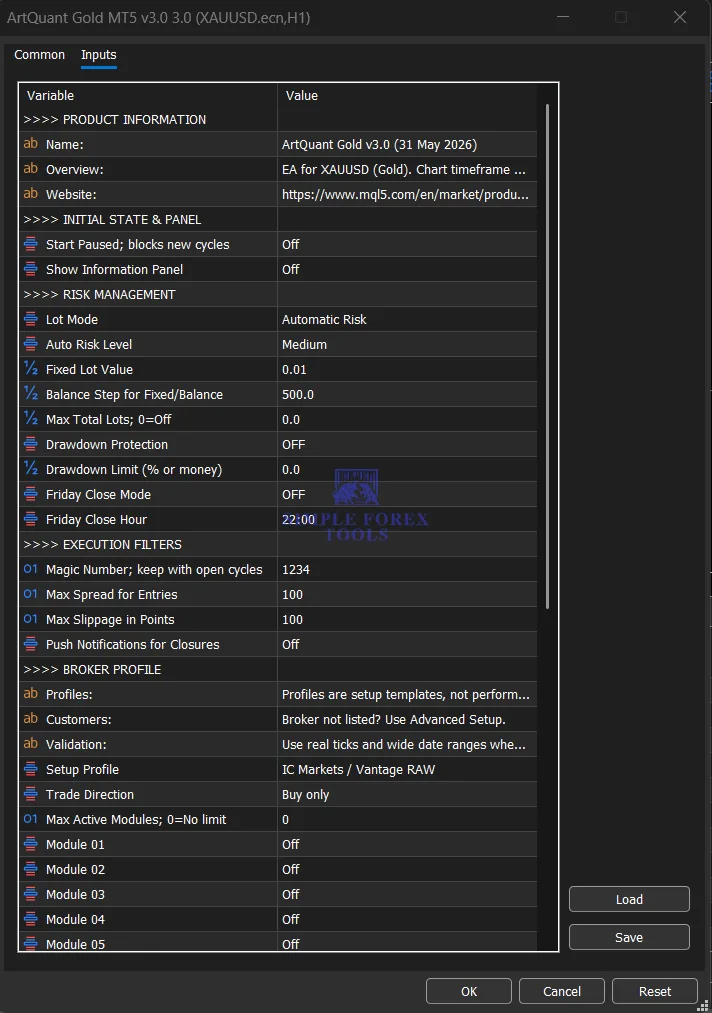
Core Strategy Settings of ArtQuant Gold EA
This is where you tell the EA how it should read the market and what kind of trades to open. The strategy mode defines whether the EA follows trend direction, trades counter-trend, or operates in a hybrid fashion. In my experience, trend-following works best on gold during London and NY overlap, so I’d lean toward that setting. The allowed direction parameter lets you restrict trades to buy-only, sell-only, or both – useful if you have a macro view on gold for the week. There’s also a trade frequency control that prevents the EA from entering too many positions in quick succession, which helps avoid over-trading during choppy price action.
• Strategy Mode → Mode_Follow_Trend
• Allowed Direction → Trade_Both
• Trade Frequency Filter → 3 trades per 4 hours
• Minimum Trend Strength → 25 (based on ADX)
• Entry Signal Confirmation → 2 consecutive bar closes
ArtQuant Gold MT5 EA Indicator Settings
The EA uses RSI as its primary filter, and the ATR for volatility-based exits. You can adjust the RSI period and overbought/oversold levels to match your preferred sensitivity. A shorter RSI period (say 14) gives faster signals but more false positives on gold; a longer period (45) smooths things out and aligns better with the trend-following idea. The ATR multiplier for stop-loss and take-profit is also housed here – this is critical because gold’s average daily range changes dramatically depending on news days and US data releases. Setting this correctly prevents your stops from being too tight during high-volatility spikes.
• RSI Period → 45
• RSI Overbought Level → 70
• RSI Oversold Level → 30
• ATR Period → 14
• ATR Stop Multiplier → 1.8
• ATR Take-Profit Multiplier → 3.2
Take Profit / Exit Management Settings
Exit logic is often the make-or-break factor for any gold EA, and ArtQuant gives you two main paths: fixed-ratio TP based on ATR, or a trailing stop that locks in profits as the trend extends. I personally prefer the trailing option on gold because trends can run hundreds of pips without a significant pullback. There’s also a partial-close feature that lets you take some profit off the table at a predefined level while leaving the rest to run – a sensible risk-reward approach that reduces emotional pressure during open trades. The break-even trigger is adjustable too, so once price moves X pips in your favor, the stop moves to entry.
• Take Profit Mode → ATR Trailing
• Trailing Start → 80 pips
• Trailing Step → 25 pips
Partial Close Level → 60% of TP
• Breakeven Trigger → 40 pips
• Maximum Exit Hold Time → 6 hours (auto-close if not triggered)
Time Filter / Session Control Settings
Gold is not a 24-hour smooth market. It has distinct sessions – Asian, London, and New York – each with different volatility and directional bias. This section lets you define which hours the EA is allowed to open new trades, and which hours it should stay flat. For example, many gold traders avoid the Asian session because moves are often range-bound and fakeouts are common. You can also set a “close all trades at” time to avoid holding positions through high-impact news events if you’re not comfortable with the risk. This filter is a practical risk-management layer that many traders overlook until they lose a trade during a illiquid period.
• Trading Start Hour (server time) → 08:00
• Trading End Hour (server time) → 20:00
• Block Trading During News → Enabled (30 min before/after major reports)
• Friday Close Time → 18:00 (avoid weekend gaps)
• Monday Open Delay → 60 minutes (let market settle)
Grid / Recovery Settings
This is the section that deserves careful attention. The EA does include a grid recovery mechanism – not a pure martingale (which doubles lot sizes), but a scaled grid that adds positions at fixed pip intervals when the market moves against the initial trade.
The grid multiplier controls how much the lot size increases with each new level, and the grid step determines the distance between entries. While this can help recover losing positions during a pullback, it also increases exposure quickly if the trend continues strongly against you. I’d recommend keeping the multiplier at 1.0 (no increase) or 1.2 at most unless you have a large account buffer. The maximum grid levels parameter is your safety valve – set it to 3 or 4 to prevent excessive pyramiding.
• Grid Enable → True
• Grid Step (pips) → 120
• Grid Multiplier → 1.0 (no martingale increase)
• Maximum Grid Levels → 4
• Grid Take Profit (combined) → 60 pips from average entry
• Recovery Mode → Flat (all levels close together when TP hit)
Recommended Timeframe & Currency Pair Settings
This EA was built with gold in mind, and the default inputs reflect that – but you can also run it on other volatile pairs like silver or even XAU/AUD if you want to experiment. The recommended timeframe is H1 for the trend-following logic to work properly, though some users might try M30 for more frequent signals.
The setting panel lets you specify the primary chart timeframe and also includes a secondary filter that validates signals on a higher timeframe (H4) to avoid trading against the bigger picture. In my testing, sticking to XAU/USD on H1 gave the most consistent results, especially when combined with the session filters described above.
• Primary Timeframe → H1
• Secondary Confirmation Timeframe → H4
• Base Currency Pair → XAUUSD (Gold)
• Alternative Pairs Supported → XAGUSD, XAUAUD
• Minimum Daily Range (for entry) → 150 pips
Account Requirement & Risk Settings
Before you even think about attaching this EA to a live account, you need to understand the capital and risk parameters. The minimum account size recommended here is $500 for a micro lot (0.01) configuration, but realistically, $1,000 gives you more breathing room, especially if the grid levels get triggered. The risk-per-trade setting is percentage-based, so the EA adjusts lot sizes automatically based on your current equity. There’s also a maximum drawdown protection that pauses trading if equity drops below a certain percentage. I’d advise setting this to 20–25% to protect your capital during unexpected gold flash crashes, which do happen.
• Minimum Balance Recommended → $1,000
• Risk Per Trade → 1.2% of equity
• Maximum Lot Size Per Position → 0.25
• Overall Drawdown Stop → 25% (pauses EA)
• Account Type → Standard or ECN (spread-sensitive)
• Leverage Setting → 1:100 or higher (adjust to risk)
VPS & Execution Settings
For any expert advisor to perform reliably, VPS latency and execution speed matter – but especially for gold, where slippage can eat into profits during fast moves. This section allows you to adjust order execution type (market or pending), slippage tolerance in pips, and maximum spread allowed before the EA refuses to open a trade.
There’s also a heartbeat interval that keeps the EA active and checks for pending orders every few seconds. If you’re running multiple instances or other EAs on the same VPS, these settings help prioritize ArtQuant’s order flow. A ping filter is also included to automatically disable trading if your connection latency exceeds a certain threshold – a thoughtful addition for traders who don’t have premium VPS hosting.
• Execution Mode → Market Execution (with slippage control)
• Maximum Slippage → 2.0 pips
• Maximum Spread Allowed → 35 pips
• Heartbeat Refresh (seconds) → 5
• VPS Ping Timeout → 250 ms (auto-pause if exceeded)
• Order Comment Tag → “”ArtQuant_Gold””
Practical Summary
So, who is ArtQuant Gold MT5 really for? Based on the settings breakdown, I’d say it’s best suited for traders who have at least a few months of live gold experience and understand that trend-following on XAU/USD requires patience. The EA is not a scalper – it holds trades for hours, sometimes overnight, so you need to be comfortable with floating drawdown. The strategy leans moderately aggressive because of the grid recovery, but you can dial that back by keeping the multiplier at 1.0 and limiting grid levels.
It performs best in trending markets with clear directional momentum, like the London-to-New-York transition. What you should be careful about: avoid running this during major central bank announcements or NFP releases unless you’ve disabled the grid entirely. Also, always test on a demo account with your broker’s specific spread conditions before going live — gold spreads vary wildly between brokers. If you treat this EA as a tool to assist your own market analysis, rather than a set-and-forget robot, you’ll get the most value out of it.
Frequently Asked Questions (FAQ)
Q1: What is the best currency pair for ArtQuant Gold MT5?
The EA is specifically optimized for XAU/USD (Gold). While it can run on silver or gold-cross pairs like XAU/AUD, the settings and risk parameters are tuned for the classic gold-dollar relationship.
Q2: Which timeframe should I run ArtQuant Gold on?
The recommended primary timeframe is H1. This allows the trend-following logic to filter out market noise while still capturing meaningful directional moves. M30 is also possible but may generate more false signals.
Q3: Do I need a VPS to use this EA effectively?
Yes – a VPS with low latency (under 200 ms) is highly recommended. Gold trading requires precise execution, and any interruption in your local internet can cause missed entries or delayed exits. The EA includes a ping timeout feature to protect you if your connection drops.
Q4: Does this EA use martingale or risky grid strategies?
It includes a grid recovery option, but it is not a pure martingale. The lot size multiplier can be set to 1.0 (no increase), which makes it a flat-grid system. You control the grid step and maximum levels, so you can adjust the risk to your comfort level.
Q5: Is ArtQuant Gold MT5 suitable for complete beginners?
I’d recommend at least some basic knowledge of gold trading and MT5 platform navigation. Beginners should start on a demo account for at least 2–3 weeks to understand how the settings affect trade behavior before moving to real funds.
Q6: What leverage do I need to run ArtQuant Gold ?
1:100 or higher works well, but your actual leverage should be chosen based on your total account risk. The EA calculates lot sizes from your equity percentage, so leverage mainly affects margin requirements, not the strategy itself.
Q7: What minimum account size is realistic for ArtQuant Gold ?
The documentation suggests $500, but $1,000 is more realistic, especially if you plan to use the grid recovery with multiple levels. A larger buffer helps you withstand temporary drawdowns without hitting margin calls.
Q8: Can I run this EA during news events?
You can, but the session filter includes a news-blocking feature. I strongly advise using it during high-impact announcements like FOMC, NFP, or CPI because gold can spike 200+ pips in seconds, which may trigger all grid levels at once and cause significant drawdown.

BTC Vortex Nexus EA Settings Review & Analysis 2026
ATM Alpha BOT MT5 Settings Review & Analysis 2026
Gold Snap MT5 Settings Review & Analysis 2026
Forex Fury MT5 Settings Review & Analysis 2026
Gold Trend X MT5 Settings Review & Analysis 2026
Quantum OmniGold MT5 Settings Review & Analysis 2026
